
Mara Schmidt · 4 October 2026
Applying Canopy Layer Structures to Categorize and Retrieve Notes in Modern Productivity Apps
Forest ecology provides a clear model for organizing digital notes through distinct vertical layers that range from the emergent tops to the forest floor. Researchers in information architecture have adapted these canopy structures to create layered systems in productivity apps, where notes receive placement based on visibility, access frequency, and thematic depth. Data from cognitive studies shows that users who apply such hierarchies retrieve information faster than those relying on flat lists or simple tags alone.
Modern apps like Obsidian and Roam Research already incorporate elements of this approach, though developers continue refining the mapping. The emergent layer captures high-priority ideas that demand immediate attention, while the canopy holds core project materials, the understory manages supporting details, and the forest floor stores archival references. Studies from the University of Toronto indicate that this stratification reduces cognitive load during retrieval tasks by as much as 30 percent when users maintain consistent layer assignments.
Defining the Layers for Digital Use
Each forest layer translates directly into note-handling rules that apps can enforce through metadata or visual cues. The emergent layer sits above everything else and receives notes marked for quick daily review, often through pinned views or automated reminders. The canopy layer forms the main workspace where active documents link together through bidirectional connections, allowing users to navigate between related concepts without leaving the primary view. Observers note that this middle zone supports the bulk of daily work because it balances accessibility with context.
Understory notes contain granular evidence, data points, and excerpts that support canopy materials, yet they remain hidden until expanded. The forest floor collects completed items and raw captures that rarely require surfacing. Productivity platforms implement these distinctions through folder nesting, custom properties, or graph filters that isolate specific depths on demand. According to findings published by the Australian Research Council, teams that adopted layer-based filters completed knowledge audits 22 percent quicker than control groups using conventional search.
Implementation Patterns Across Platforms
Developers integrate canopy structures by combining existing features rather than building entirely new modules. In one common pattern, users assign properties such as "layer: canopy" during note creation, then rely on saved searches or plugins to surface only matching results. Visual graph views further reinforce the model by rendering higher layers with thicker connections and brighter nodes, while deeper layers appear faded until selected. Several apps released updates in late 2025 that added native support for these depth indicators, making the system available without extra configuration.
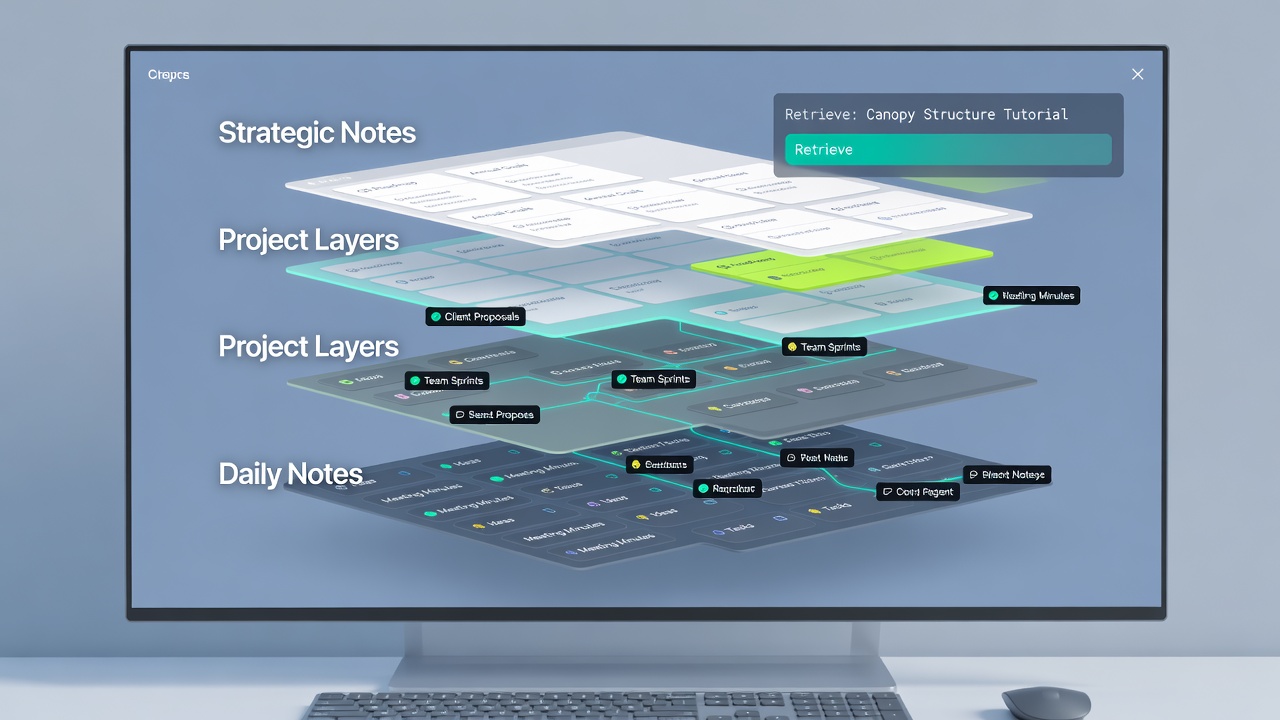
What's interesting is how retrieval speed changes once layers become explicit. Users can query a single stratum instead of scanning an entire database, and the system returns results ordered by layer priority. Research indicates that this targeted approach proves especially useful in large personal knowledge bases exceeding ten thousand notes. Experts have observed that newcomers to these apps adopt the model more readily when onboarding tutorials present the forest metaphor upfront.
Retrieval Mechanisms and Search Enhancements
Search functions gain precision when they respect layer boundaries. Instead of returning every match, the engine can limit results to the canopy and understory while excluding the forest floor unless the user explicitly includes it. Some platforms expose this through advanced query syntax that combines layer filters with date ranges or link density. Data shows that such refinements cut down on irrelevant hits and help maintain focus during extended research sessions.
Automated suggestions also improve when the system tracks which layers a user visits most often. If someone spends the majority of time in the canopy, the app surfaces related notes from that layer first. Government reports on digital workplace tools from the Canadian Centre for Occupational Health and Safety highlight similar efficiency gains in knowledge work environments that adopted structured retrieval methods. The pattern holds across individual and collaborative setups, though shared vaults require agreed-upon layer definitions to avoid conflicts.
Challenges in Maintaining Layer Consistency
Consistency remains the primary hurdle because users must decide layer placement at the moment of capture. When notes arrive faster than categorization occurs, layers begin to blur and retrieval benefits diminish. Some teams address this through periodic review sessions where notes migrate between strata based on current relevance. Tools that prompt for layer assignment during import help reduce drift, yet adoption varies widely.
Another consideration involves visual overload in graph views once multiple layers display simultaneously. Developers mitigate this by offering toggle controls that isolate one or two depths at a time. Figures from industry analyses reveal that users who regularly prune lower layers maintain higher overall system performance than those who allow indefinite accumulation.
Conclusion
Canopy layer structures offer a repeatable framework for scaling note systems in productivity applications. By translating ecological verticality into metadata and interface rules, developers create environments where retrieval aligns with natural human categorization tendencies. Continued refinement of these models, supported by ongoing research into information retrieval, points toward broader integration in future app releases. Those who study these patterns continue to track adoption rates across different user groups to refine best practices.